💱 Exchange rates used in this article (August 2026): €1 = MUR 54 / USD 1 ≈ MUR 46. Euro and dollar amounts are rounded for reference.
From Budget Speech to Finance Act: how does it work in Mauritius?
In Mauritius, the budget legislative process follows three steps:
- The Budget Speech — the Prime Minister’s address to the National Assembly. It announces the main directions. It’s a statement of intent, not yet a law.
- The Finance Bill — the draft legislation that translates these announcements into legal text. It is submitted to Parliament for debate and vote.
- The Finance Act — the final text, once voted and signed by the President of the Republic, then published in the Official Gazette (Government Gazette). This is when measures have the force of law.
For 2026:
- Budget Speech: 19 June 2026
- Finance Bill introduced to Parliament: 24 July 2026
- Finance Act signed and published: 12-13 August 2026 (Act No. 14 of 2026, Government Gazette No. 59 of 13 August 2026)
Unlike my Budget article published in June — which was based on announcements — this article is based on the final official texts. What is written here has the force of law.
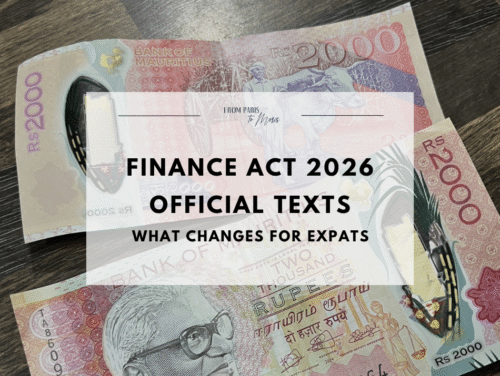
The Finance Act 2026 is official. After the Budget Speech of 19 June, parliamentary debates and the promulgation of 12 August — here is what concretely applies if you are an expat in Mauritius or preparing your move.
I have read both official texts in full to extract what matters to you. Here is what you really need to know.
1. Residence permits: the full picture
Let’s start with a clear summary — which permits are affected, which are unchanged.
| Permit | Affected by Finance Act 2026? |
|---|---|
| Investor Occupation Permit | ✅ Yes — revised thresholds |
| Self-Employed Occupation Permit | ✅ Yes — revised thresholds |
| Professional Occupation Permit | ✅ Yes — with transitional provision |
| Family Occupation Permit | ❌ Permanently abolished |
| Golden Visa | ✅ New permit created |
| Retired Permit | = No change |
| Premium Visa | = No change |
| Dependent Permit | = No change |
2. Permits in detail
Investor Occupation Permit
The Investor Occupation Permit is for foreign entrepreneurs who create or take over a business in Mauritius. It grants the right to reside and work in Mauritius within the scope of the declared activity.
The minimum investment threshold is doubled: from USD 50,000 to USD 100,000 (~MUR 4,600,000 / ~€46,000).
Renewal criteria are now set as follows:
| Criterion | Before Finance Act 2026 | After Finance Act 2026 |
|---|---|---|
| Minimum investment | USD 50,000 (~MUR 2,300,000 / ~€23,000) | USD 100,000 (~MUR 4,600,000 / ~€46,000) |
| Turnover year 3 | MUR 1.5 million (~€28,000) | MUR 5 million (~€93,000) |
| Turnover year 5 | MUR 20 million cumulative (~€370,000) | MUR 8 million/year (~€148,000) |
⚠️ The turnover-based renewal thresholds have increased significantly. A business generating real revenue from year 3 is now essential, not optional.
Self-Employed Occupation Permit
The Self-Employed permit is for freelancers, consultants and independent workers who operate their main activity from Mauritius. It does not require creating a company or employing staff — it is the most accessible permit for digital nomads and independent workers.
| Criterion | Before Finance Act 2026 | After Finance Act 2026 |
|---|---|---|
| Initial investment | USD 50,000 (~MUR 2,300,000 / ~€23,000) | USD 50,000 (unchanged) |
| Turnover year 3 | MUR 750,000 (~€14,000) | MUR 2 million (~€37,000) |
| Turnover year 5 | MUR 6 million cumulative (~€111,000) | MUR 3 million/year (~€55,500) |
⚠️ The turnover-based renewal thresholds have increased significantly. A business generating real revenue from year 3 is now essential.
Professional Occupation Permit (employee)
The Professional permit is for foreigners recruited by a Mauritian company as an employee. Previously, two categories existed (ProPass and Expert Pass) with different salary thresholds depending on the sector.
| Criterion | Before Finance Act 2026 | After Finance Act 2026 |
|---|---|---|
| ProPass (min. salary) | MUR 30,000/month (~€555) | — |
| Expert Pass (min. salary) | MUR 250,000/month (~€4,630) | — |
| Single minimum salary | Variable by sector | MUR 50,000/month gross (~€925) |
| Sectors concerned | Variable | All sectors |
✅ Important transitional provision: if you already hold a Professional OP, your first renewal will be assessed under the old criteria, not the new ones. This transitional protection is written into the official text.
Family Occupation Permit: permanently abolished
The Family Occupation Permit was a 10-year residence permit created during the Covid period. To benefit from it, a family had to contribute USD 250,000 (~MUR 11,500,000 / ~€230,000) to the Mauritian COVID-19 Projects Development Fund. In return, the applicant, their spouse, dependent children and parents received the right to reside and work in Mauritius for 10 years.
This permit no longer exists. The Finance Act 2026 permanently removes its definition and all references from the law.
Golden Visa: the new premium permit
The Golden Visa is a new official category created by the Finance Act 2026. It is aimed at wealthy investors wishing to settle in Mauritius with significant tax advantages.
Official definition in the legislation:
“A visa issued by the passport officer under the Passports Act to a non-citizen on the recommendation of the Economic Development Board”
Eligibility criteria:
- Invest a minimum of USD 1 million (~MUR 46,000,000 / ~€925,000) in a business activity in Mauritius
- The investment must be made within 12 months of the visa being issued
- ⚠️ The purchase of residential property under EDB property schemes is not eligible as a qualifying investment — the law is explicit on this point
Tax advantages:
- Foreign-source income is only taxed in Mauritius if repatriated to the island
- Expenses paid by a foreign bank card in Mauritius are not considered a repatriation
- Funds deposited in a Mauritian bank account are not taxable if taxes have already been paid abroad
💡 In plain terms: a Golden Visa holder can live in Mauritius, use their French bank card for everyday spending, and not be taxed on those funds in Mauritius. This is a highly attractive fiscal arrangement for high-net-worth individuals looking to invest in business activities in Mauritius.
3. Permits in digital format — a welcome modernisation!
Residence, occupation and work permits will now be issued in digital format, in addition to paper and card format. A real practical improvement for expats who are tired of carrying plastic cards everywhere.
4. The Digital Travel Authorisation: a new system — distinct from the current form
You are probably already familiar with the Mauritius All-in-One Travel Digital Form — the free form to complete on safemauritius.govmu.org within 72 hours before departure, which generates a QR code to present on arrival. It has been in place since December 2021 and you likely complete it before every trip. This form remains unchanged.
The Digital Travel Authorisation from the Finance Act 2026 is a different, new system — a paid pre-authorisation to obtain before travelling, comparable to the US ESTA or the Australian ETA. It will apply to all non-citizens without exception — tourists, prospective residents, and people in the process of applying for a permit.
The official text:
“A person shall, prior to being admitted in Mauritius, be the holder of a digital travel authorisation. An application shall be made, prior to travelling to Mauritius, electronically to the immigration officer on payment of such fee as may be prescribed. The Minister may exempt any person or class of persons.”
What we know:
- It is an entry authorisation — not an exit one
- Fees will apply (amount not yet set)
- Certain categories may be exempted by ministerial decision
- It is not yet in force — deployment expected during 2027 after technical development
⚠️ If you make frequent trips to Mauritius during your permit application (medical tests, EDB appointments), this authorisation will need to be obtained before each trip once the system is live. Watch this space.
5. Real estate: an important correction on registration duties
✅ EDB registration duties remain at 5%
The Finance Act 2025 had planned to double registration duties from 5% to 10% for non-citizens on all acquisitions through EDB schemes (IRS, RES, PDS, Smart City, G+2 on private land) from 1 July 2026.
The Finance Act 2026 cancels this measure. Registration duties remain at 5% for all approved EDB schemes. ✅
💡 On a property worth MUR 6 million (~€111,000), this represents a saving of MUR 300,000 (~€5,550) compared to what had been planned.
⚠️ 10% levy on resale — State land only
First, an essential explanation: what are the Pas Géométriques?
The Pas Géométriques refer to the strip of land running along the Mauritian coastline that belongs to the State. Historically, this strip of approximately 81 metres from the high-water mark is considered public domain — no one can own it. However, developers had obtained leases from the State on this coastal strip to build seafront apartments, which were then sold to foreigners. This is precisely the mechanism the government is now regulating.
The 10% levy applies only if:
- The apartment is G+2 (building of at least 2 floors above ground level)
- It is built on State land or Pas Géométriques (public coastline)
- The sale price is at least MUR 6 million (~€111,000)
- The buyer is a non-citizen
The 10% levy does NOT apply if:
- ✅ The apartment is built on private land — standard EDB schemes (IRS, RES, PDS, Smart City, private G+2) are not affected
- ✅ A notarial reservation contract was signed before 19 June 2026
- ✅ The sale is to a Mauritian citizen
⚠️ This levy is payable by the seller, not the buyer — but it may obviously affect the sale price.
6. Income tax: the new official rates
The new income tax schedule has been effective since 1 July 2026.
Before 1 July 2026
| Annual taxable income | Rate |
|---|---|
| Up to MUR 500,000 (~€9,300) | 0% |
| MUR 500,001 to MUR 1,000,000 (~€9,300 to ~€18,500) | 10% |
| Above MUR 1,000,000 (~€18,500) | 20% |
| Very high incomes | 20% + Fair Share Contribution (variable) |
For reference: before July 2025, Mauritius applied a flat tax of 15% on all income.
From 1 July 2026 (Finance Act 2026)
| Annual taxable income | Rate |
|---|---|
| Up to MUR 500,000 (~€9,300) | 0% |
| MUR 500,001 to MUR 1,000,000 (~€9,300 to ~€18,500) | 10% |
| MUR 1,000,001 to MUR 12,000,000 (~€18,500 to ~€222,000) | 20% |
| Above MUR 12,000,000 (~€222,000) | 35% |
| Fair Share Contribution | Abolished ✅ |
What this means for you in practice:
For the vast majority of expats, nothing changes. The 0/10/20% brackets remain identical. The new 35% rate only applies to income above MUR 12 million/year, equivalent to approximately €222,000/year — a threshold very few expats reach. And the abolition of the Fair Share Contribution simplifies and reduces the tax burden for high earners.
The 35% rate remains highly competitive compared to France, where the top marginal rate reaches 45%.
Sector-specific exemption:
Non-citizen employees working in the manufacturing of solar photovoltaic systems benefit from a 4-year income tax exemption. A niche sector, but worth noting if you work in renewable energy.
Summary
| Measure | Impact | Effective |
|---|---|---|
| Investor OP | ⚠️ USD 100K + MUR 5M (~€93K) yr3 / MUR 8M (~€148K) yr5 | Immediate |
| Self-Employed OP | ⚠️ MUR 2M (~€37K) yr3 / MUR 3M (~€55.5K) yr5 | Immediate |
| Professional OP | ⚠️ MUR 50,000/month (~€925) — transitional provision 1st renewal | Immediate |
| Family OP | ❌ Permanently abolished | Immediate |
| Golden Visa | ✅ New — USD 1M (~€925K), tax advantages | Immediate |
| EDB registration duties | ✅ Remain at 5% (doubling cancelled) | Immediate |
| 10% levy G+2 State land | ⚠️ Seller only | Immediate |
| G+2 private land | ✅ No additional levy | — |
| Digital permit format | ✅ Available in addition to physical format | Immediate |
| Income tax schedule | ✅ 35% above MUR 12M/year (~€222K) | 1 July 2026 |
| Fair Share Contribution | ✅ Abolished | 1 July 2026 |
| Digital Travel Authorisation | ⚠️ New paid system for all non-citizens (distinct from current form) | ~2027 |
My key takeaways for you
The Finance Act 2026 sends a consistent message with the Budget Speech: Mauritius is raising the bar to attract serious profiles. Thresholds are going up, criteria are getting clearer — but the island remains deeply attractive for those who arrive prepared.
The most important points:
If you are preparing an Occupation Permit: renewal thresholds have risen significantly. Coming with a documented project and a real revenue generation strategy is now essential, not optional.
If you are considering buying property in Mauritius: registration duties remain at 5% — good news. Make sure the property you are targeting is on private land, not State land or the public coastline.
If you travel frequently to Mauritius: keep completing your All-in-One Travel Form as before. The new paid Digital Travel Authorisation is not yet in force — expected around 2027.
👉 Book a coaching session — €50
👉 Download the free checklist
Official sources:
- The Finance Act 2026 — Act No. 14 of 2026, signed 12 August 2026, Government Gazette of Mauritius No. 59 of 13 August 2026
- The Economic and Financial Measures (Miscellaneous Provisions) Act 2026 — Act No. 13 of 2026, signed 12 August 2026, Government Gazette of Mauritius No. 59 of 13 August 2026
- Budget Speech 2026/2027 — presented on 19 June 2026 by Prime Minister Navinchandra Ramgoolam to the National Assembly of Mauritius
⚠️ This article is a practical overview based on the official published texts. It does not constitute legal or tax advice. Please consult a professional before making any decision.
Further reading
Read also