Last updated: June 2026
⚠️ Important: these measures are not yet law. They will come into force once the Finance Act is voted — typically 1 to 2 months after the Budget Speech. Until then, the exact terms may change.
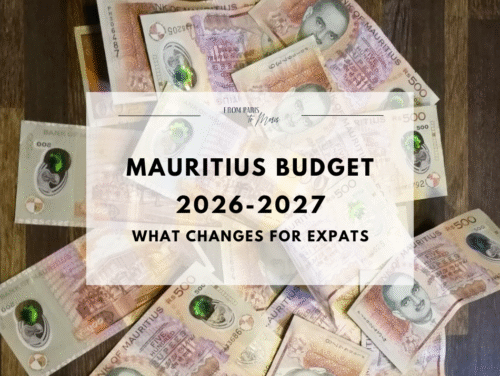
The information below comes from the 2026/2027 Budget Speech, delivered on 19 June 2026 by Prime Minister Navinchandra Ramgoolam before the National Assembly of Mauritius. These measures may be amended when the Finance Bill is voted and the implementing texts are published. This article is a practical overview — not legal advice. Sources: official 2026/2027 Budget Speech, EDB Mauritius Budget Highlights, MCCI Budget Highlights.
Mauritius has just unveiled its 2026/2027 Budget. There’s a lot to read, a lot of announcements, and honestly — it’s not always easy to figure out what actually concerns you when you’re planning your move to the island. That’s exactly why I’ve broken down this speech for you. Here, section by section, is what these announcements really mean if you’re considering relocating to Mauritius.
1. Residence permits: what’s changing?
This is the section future expats care about most — and there’s news. The 2026/2027 Budget announces several adjustments to the criteria for residence and work permits, subject to the implementing texts.
Investor Occupation Permit
The minimum initial investment threshold is revised to USD 100,000 — suggesting the removal of the current USD 50,000 option, subject to confirmation by the Finance Act. Performance criteria are now introduced at renewal: a minimum annual turnover of MUR 5 million by year 3, then MUR 8 million by year 5. In practice, this means your business must show real and growing activity to remain eligible — good for the credibility of the scheme, but it requires a genuine growth strategy from the outset.
Self-Employed Occupation Permit
Same logic: minimum business income thresholds are introduced at renewal. MUR 2 million by year 3, MUR 3 million by year 5. The message is clear — Mauritius wants self-employed individuals who run a real, income-generating activity.
Professional Permit (employee)
The minimum monthly salary required is set at MUR 50,000/month, now applying across all sectors — a notable harmonisation compared to the previous sector-specific thresholds.
ProPass / Expert Pass merger
The two programmes — ProPass and Expert Pass — are being merged into a single scheme. Less administrative complexity, in principle, but the details remain to be confirmed.
Abolition of the Family Occupation Permit
The Family Occupation Permit is being abolished. This permit, created during the Covid period, allowed a family to obtain a residence permit in exchange for a contribution of USD 250,000 (or its equivalent in freely convertible foreign currency) to the COVID-19 Projects Development Fund. Its removal means this specific route is no longer available: families will now need to go through the other permit categories (Investor, Self-Employed, Professional…) depending on their situation.
If you were counting on this permit for your project, don’t worry: there’s almost always another suitable route. A coaching session is exactly what helps reassess the best option for your personal situation.
Digital permit and E-Visa before arrival
Good news on the practical side: residence permits will be issued in digital (card) format. And an E-Visa can be applied for before arriving on the island, which should simplify the first steps for newcomers.
2. The new Golden Visa: who is it for?
This is the big new measure for high-end investor profiles. Mauritius is introducing a Golden Visa for investors who place a minimum of USD 1 million in sectors defined as priorities — within their first year of stay.
The eligible sectors announced: FinTech, global treasury, artificial intelligence, biotechnology, and renewable energy.
This scheme clearly positions Mauritius as a destination for tech and finance entrepreneurs and investors. If your profile fits, it’s worth keeping a close eye on the implementing texts. If you’re considering an investment project in Mauritius in these sectors, now is the time to think it through seriously — subject to confirmation by the Finance Bill.
3. Income tax: the new brackets
| Annual taxable income | Before | After (Budget 2026/27) |
|---|---|---|
| Less than MUR 500,000 | 0% | 0% |
| MUR 500,000 – 1,000,000 | 10% | 10% |
| MUR 1,000,000 – 12,000,000 | 20% | 20% |
| Above MUR 12,000,000 | 20% + contribution | 35% |
An important nuance for those affected by the top bracket: the previous system (the 15% Fair Share Contribution) included dividends in its calculation base. The new single 35% rate, however, is expected to exclude dividends — but this point remains subject to the final vote of the Finance Act. If a significant share of your income comes from dividends, this is something to watch closely and confirm with a certified accountant once the law is passed.
What this changes for you: if your income is below MUR 12 million per year (the case for the vast majority of expats), your taxation doesn’t change. The 0 / 10 / 20% brackets remain identical. The change only affects very high incomes (above MUR 12 million/year): they are now taxed at 35%, a single rate replacing the previous system (20% + a 15% Fair Share Contribution).
What it looks like in practice: let’s take an example — an expat employee earning MUR 2,000,000 per year (around €40,000). Their tax would be calculated as follows: MUR 0 on the first bracket, MUR 50,000 on the 10% bracket (500K–1M), and MUR 200,000 on the 20% bracket (1M–2M) — a total of MUR 250,000 in tax, roughly a 12.5% effective average rate. Still very competitive compared to France, but it replaces a simple flat structure with progressivity to watch depending on your income level.
⚠️ These rates are announced in the Budget Speech — to be confirmed by the Finance Bill.
4. Real estate: what’s changing for foreigners
The budget introduces clarifications and targeted restrictions — but the main purchase routes remain open.
What remains possible ✅
Foreign nationals can still buy property in Mauritius through EDB-approved schemes: IRS, RES, PDS, Smart City, and G+2 apartments in privately-owned buildings (minimum price MUR 6 million, ~€109,000, subject to EDB approval). These routes are unaffected.
What has been prohibited since the 2025/2026 Budget ❌
The purchase of G+2 apartments built on State land or on the coastline is prohibited for non-citizens. In plain terms: beachfront apartments built on public land are no longer accessible to foreigners. This measure was introduced in the 2025/2026 Budget and is confirmed and reinforced in 2026/2027.
What the 2026/2027 Budget adds ⚠️
The State will no longer grant new G+2 leases on State land or coastline authorising sales to non-citizens. In addition, a special 10% levy now applies to the resale of these apartments, payable by the seller. Notarial reservation contracts already signed are grandfathered — meaning if you’ve already signed, you’re not affected.
What about registration duties?
Since 1 July 2026, registration duties for non-citizens across all EDB schemes (IRS, RES, PDS, Smart City, private G+2) have doubled from 5% to 10%. This is a significant additional cost to factor into your acquisition budget — regardless of which approved scheme you choose.
What this means for you
If you’re considering buying property in Mauritius as part of your relocation project, the approved EDB schemes remain your go-to route. The rules are tighter and the costs are higher than a few years ago — but the framework is clear. As always, working with a notary and an EDB-accredited adviser before signing anything is strongly recommended.
⚠️ These measures come from the 2025/2026 and 2026/2027 Budgets — subject to confirmation by their respective implementing texts.
5. Cost of living: what to expect
A few tax adjustments that will have an impact on daily life — modest, but real.
Taxes on food and drinks
The sugar tax is extended to new product categories: sweets, biscuits, jams and chewing gum — from 1 October 2026. Excise duties rise by 10% on spirits and tobacco. Good news for wine and beer lovers: wine and beer remain unchanged.
Plastic and digital
The MUR 2 plastic tax is extended to all plastic bottles — again from 1 October 2026. In return, e-books are exempt from VAT. And no VAT increase is on the agenda.
Purchasing power protected on essentials
The STC (State Trading Corporation) continues to sell essential goods with capped margins, and subsidies on basic necessities are being extended. For families settling in Mauritius, that’s a welcome measure of stability.
6. Health and family: what’s new
Watch the impact on insurance
A 5% tax is introduced on short-term general insurance, effective 1 January 2027. In practice, this will affect the cost of your health, home and vehicle insurance in Mauritius. The exact impact remains to be quantified depending on your coverage, but it’s something to anticipate in your relocation budget.
Great news for expat parents employed by a company in Mauritius
Two measures that directly concern expat families:
- Maternity leave extended to 12 months: 6 months at full pay + 6 optional months at half pay — a remarkable step forward.
- Paternity leave extended to 6 weeks — again, a significant improvement by regional standards.
For couples planning to start or grow their family in Mauritius, this is a real advance — and one more argument in favour of relocating.
What I’m taking away for you
This Budget sends a clear message: Mauritius wants to attract qualified profiles, serious investors, and entrepreneurs with a structured project. The criteria are rising — but the island remains deeply attractive for those who arrive prepared.
What to remember:
- ✅ Permit thresholds are rising → come with a solid, well-documented project
- ✅ The abolition of the Family OP is a major point of attention for couples
- ✅ Real estate for foreigners is tightening on certain types of property
- ✅ Taxation remains very competitive, even with the new progressive brackets
- ✅ Families and parents benefit from real social advances
These changes make proper guidance even more valuable. It’s better to arrive with the right information from the start than to discover a restriction once you’re on the island.
👉 Download the free checklist — all the steps to prepare your move to Mauritius, in the right order.
👉 Book a coaching call — 1 hour to review your specific project and make sure you choose the right permit.
⚠️ Disclaimer: All measures mentioned in this article are announcements from the 2026/2027 Budget Speech, delivered on 19 June 2026 before the National Assembly of Mauritius. They may be amended when the Finance Bill is voted and when the implementing texts are published. This article is not legal or tax advice. Consult a professional (lawyer, certified accountant, immigration adviser) before making any decision based on this information. Sources: official 2026/2027 Budget Speech (National Assembly), EDB Mauritius Budget Highlights 2026/27, MCCI Budget Highlights 2026/27.
Read also