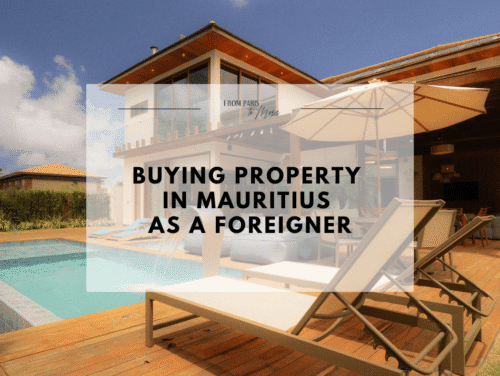

It’s one of the questions I get asked most often by future expats: is it actually worth investing in property in Mauritius?
Short answer, yes. The market has been growing steadily for years, and a well chosen property here has a real chance of gaining value over time. The longer answer is a bit more nuanced. As a foreigner, you can’t just buy any property you like. Access is regulated, restricted to a specific set of approved schemes, and the rules around it actually shifted this year.
What foreigners are actually allowed to buy
Contrary to a common assumption, there’s no unrestricted right to buy for non-citizens. Acquisitions have to go through schemes approved by the Economic Development Board (EDB): IRS, RES, PDS, Smart City, or apartments in a building of at least ground floor plus two storeys built on private land.
In practice, that means the property you have your eye on could be completely out of reach as a foreigner, even if you have the cash to pay for it outright. It’s a point a lot of people discover too late, after already viewing and negotiating on a property that doesn’t fit into any of these frameworks.
The real change from the Finance Act 2026 (and the good news it brings)
Last year, the 2025/2026 budget announced a doubling of registration duty for non-citizens, from 5% to 10%, due to take effect on 1 July 2026 across all EDB schemes.
The Finance Act 2026, passed since, has walked this measure back. Registration duty stays at 5% for all approved EDB schemes. On a property worth 6 million rupees (around €111,000), that’s a saving of roughly 300,000 rupees compared to what had been planned. Good news for anyone who put their project on hold while waiting to see how things would land.
The new thing to know about: a 10% tax on certain resales
In exchange, the government introduced a more targeted measure, which is worth explaining properly.
First, it helps to understand what “Pas Géométriques” are. It’s the strip of land running along the Mauritian coastline, roughly 81 metres from the high water mark, which belongs to the State. No one can privately own it. Some developers had nonetheless obtained State leases on this strip to build seafront apartments, later sold on to foreigners. It’s precisely this mechanism that’s now being regulated.
A 10% tax now applies on resale if, and only if, all of the following apply:
- the apartment is G+2 (a building of at least two storeys above ground floor)
- it’s built on State land or on the Pas Géométriques
- the sale price is at least 6 million rupees
- the buyer is a non-citizen
It doesn’t apply if the property is built on private land (so the classic schemes IRS, RES, PDS, Smart City and private-land G+2 aren’t affected), if a notarised reservation contract was signed before 19 June 2026, or if the sale is made to a Mauritian citizen.
One last point that reassures a lot of people: this tax is borne by the seller, not the buyer. It can obviously feed into the sale price, but it isn’t an extra line on your own acquisition bill.
How to avoid falling for a property you’re not actually allowed to buy

With this level of regulation, the biggest risk is falling in love with a property during a viewing without knowing whether it’s actually accessible to foreigners.
That’s where a tool like Noukaz comes in handy. The platform lets you filter listings directly with a “foreign buyer” option, so you only see properties that are genuinely eligible instead of wasting time on a place you can’t legally buy.
If you want to go deeper, their guide on what a foreigner is allowed to buy in Mauritius is up to date with the Finance Act 2026 and answers most of the questions that come up early in a property project: whether a local bank loan is possible, how a purchase connects to a residence permit, and what the extra fees around an acquisition actually look like.
One thing worth keeping in mind on that last point: buying property through an approved scheme doesn’t automatically grant a residence permit. You need to invest at least $375,000 USD for a residence permit to come with the deal, with an actual application filed with the EDB.
Either way, before setting your heart on a specific property, take the time to check which scheme it falls under. It’ll save you a lot of disappointment, and it’ll put you in a stronger position to negotiate.
Planning your move to Mauritius too?
A property purchase often raises other questions (permits, taxation, day to day life on the ground). I can help you get clarity in a 1-hour video call, with a personalised recap and a free resource sheet.