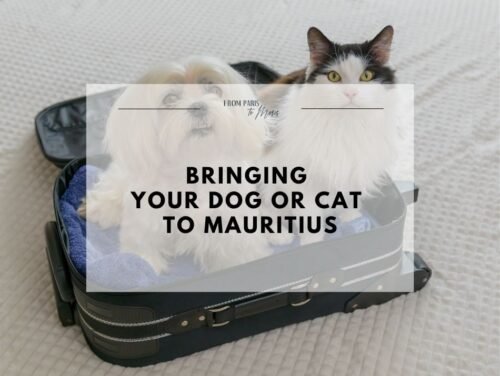
Many families preparing their relocation to Mauritius ask me the same question: can you bring your dog or cat with you? The answer is yes, but it’s an administrative and health process that requires significant advance planning – rarely less than five months. Here’s what you need to know before you start.
How much time do you need?
Allow five to six months between starting the process and the day your pet sets foot in Mauritius. This timeline isn’t arbitrary: it comes directly from the health requirements imposed by the Mauritian authorities, and in particular the anti-rabies protocol, which alone requires several months of unavoidable waiting. Leave it any later than that, and you risk having to push back your whole move.
Required vaccines and tests
Your pet must be up to date on several vaccines depending on whether it’s a dog (distemper, infectious hepatitis, leptospirosis, parvovirus) or a cat (typhus, feline rhinotracheitis, calicivirus), in addition to the rabies vaccine which is mandatory for all animals. Each injection requires a waiting period before travel is permitted, and if it’s the very first vaccination, a booster is needed one month later before that waiting period can begin.
The rabies vaccine alone is not enough: it must be confirmed by a blood test (antibody titration), carried out in an approved laboratory. Between the vaccine, the blood test and the result that finally clears your pet to travel, several months can pass. This is often the point that catches families most off guard.
For dogs, two additional blood tests (for two specific diseases) are required in the weeks before departure.
The trap almost no one sees coming
Here’s what catches people out most often: the Mauritian import permit has a very short validity period, around one month. It can only be applied for once certain test results have been obtained – and those tests must themselves be carried out within a narrow window before departure. And to calculate that window with certainty, you need to have already booked your flight. The result: flights, tests and permits all need to be coordinated at almost the same time, in a very specific order. One step out of sync, and the whole timeline shifts.
The import permit and the paperwork
The import permit is issued by the Mauritian Division of Veterinary Services (DVS), based on a complete application: test results validated by an official vet, a sterilisation certificate (with exceptions for purebred breeding animals), an up-to-date health record, and several administrative documents related to your own relocation project. Without a valid work or residence permit, it is not possible to import a pet: tourist and student visas do not allow it.
How does a pet travel to Mauritius?
Whether dog or cat, your pet always travels in the hold, never in the cabin, in an internationally approved transport crate. It must be large enough for the animal to stand up, turn around and lie down comfortably. All travel documents are attached to the crate – it’s a good idea to keep a copy with you in case anything goes missing.
Arrival and quarantine
On arrival, Mauritian veterinary services take charge of the animal directly and bring it to quarantine, for a minimum of five days (longer depending on the country of origin). Contrary to the image people sometimes have, it’s not a period of total anxiety: almost daily visits are allowed, with walks in an enclosed outdoor space. It’s a step to prepare for psychologically – for the animal and its owners – but it is well supervised and short.
What does it cost?
It’s difficult to give a single figure: the budget depends on the number of animals, their weight, the distance and the service providers chosen. Between vet fees, air transport (cargo only), customs and import fees, and on-site quarantine, budget somewhere between €2,000 and over €4,000 depending on your situation (€1 ≈ 54 MUR for costs billed locally in Mauritius).
The mistakes that cost the most
- Underestimating the health timelines, particularly for the rabies antibody titration.
- Booking your flight without having planned the upcoming test window.
- Choosing a transport crate that’s too small and gets rejected at the last minute.
- A mismatch between the microchip number and the documents in the file, which can on its own cause the entire application to be rejected.
What now?
If you’re planning your move to Mauritius with a pet, feel free to send your questions by email to info@fromparistomoris.com – I’m happy to help.
READ ALSO
→ Visas & residence permits in Mauritius: 2026 guide